
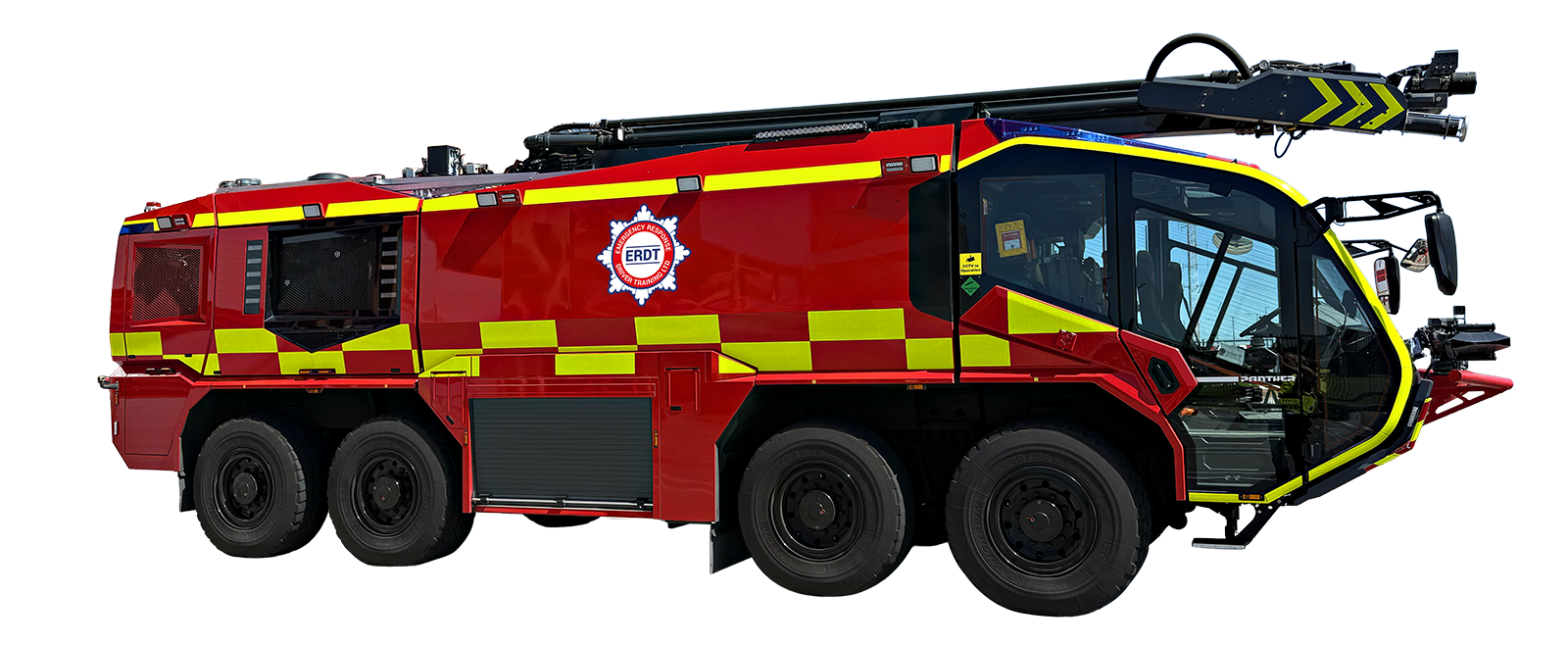
The initial and re-assessment Airport Emergency Response Driving Instructor courses (A-ERDI) provide advanced/defensive and emergency response driving Instructor skills, knowledge and understanding required to instruct driving a vehicle safely under emergency response conditions while responding to an incident Airside.
Additionally Landside Instructor Units
The course offers four optional landside public road response Instructor units, which include advanced driving response, emergency lights and sirens response, road speed response and high-speed response.
Optional HRET Instructor Unit
The instructor – High Reach Extendable Turret (HRET-I) course offers an optional unit which is designed to provide the skills and knowledge to effectively instruct HRET operates.
Training is based on the following regulatory requirements, guidance and standards:
- The International Civil Aviation Organization (ICAO) Airport Services Manual Part 1
- The UK Civil Aviation Authority (CAA) CAP 699 Unit: AFF2 & AFF6.
- National Fire Protection Association (NFPA) Standard 1010.
- NFPA Standard 414 and FAA standard for ARFF (HRET) Operation.
- The General Civil Aviation Authority (GCAA) UAE (CAR AGA PART TRG 2025).
- European Aviation Safety Agency (EASA) GM1 ADR.OPS. B.010 (a) (3).
- UK National Fire Chiefs Council (NFCC) Emergency Response Driving Framework.
Course Structure
The course provides the learner with the opportunity to complete mandatory units, additional units and two optional units, Instructor HRET and Instructor Vehicle & Pump.
The course can be delivered using heavy, medium or light vehicles.
All courses are SFJ Awards Certificate of Achievement Accredited.
SFJ Awards Certificate of Achievement provides assurance that the training programs has defined learning outcomes and assessment criteria and are internally and externally quality assured.
Pre-Course Requirements
Instructor will be required to have completed and ERD driver or HRET driver operator course prior to attending the ERDI or vehicle and pump instructor course.
The pre-course requirements for the vehicle and pump instructor course are the instructor must be experienced vehicle and pump operator.
Valid For: 4 Years.
